
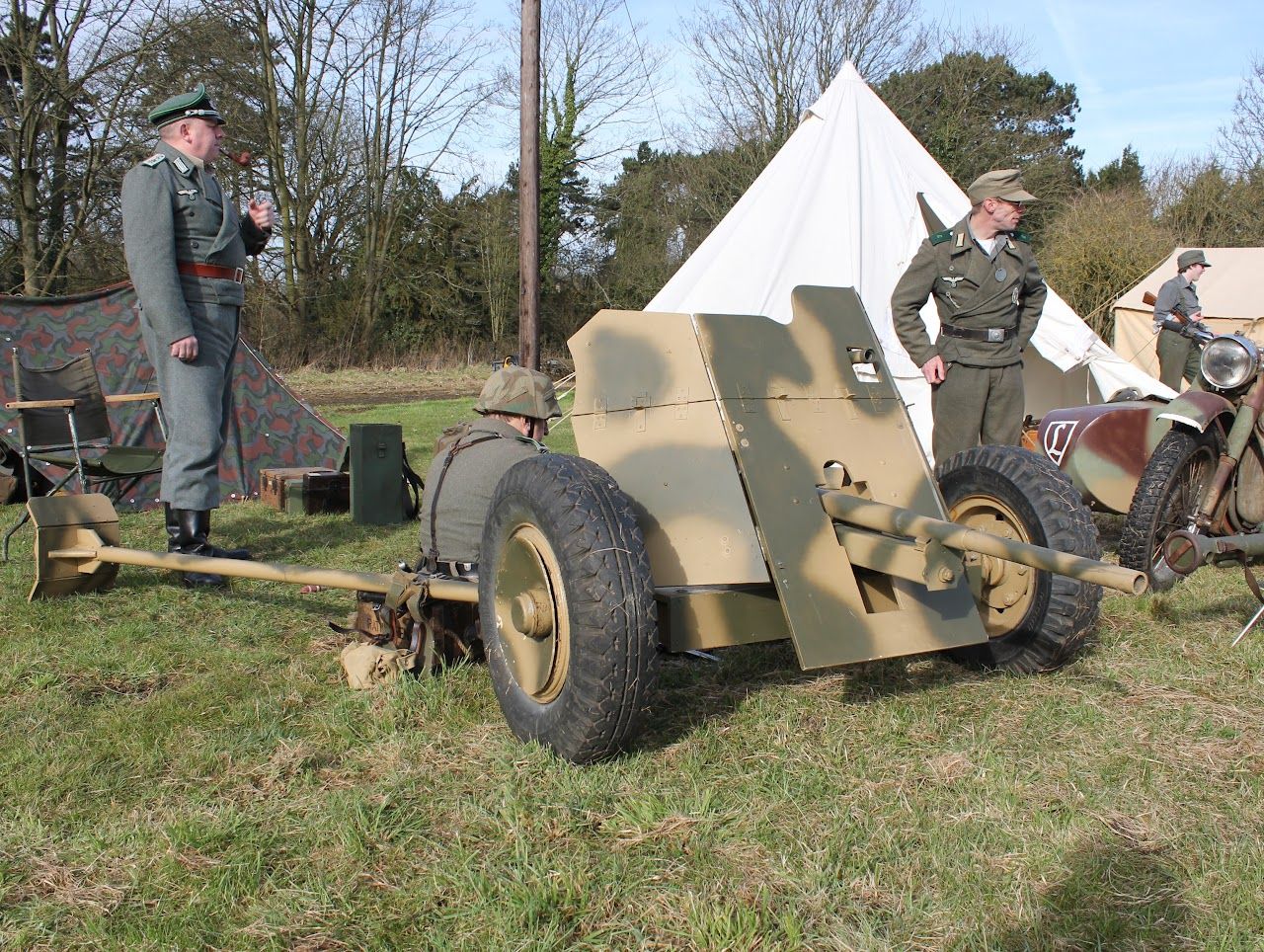
Grenadier loadout
The basic uniform and field kit for a Grenadier, and what every new member should get first.
What to get first
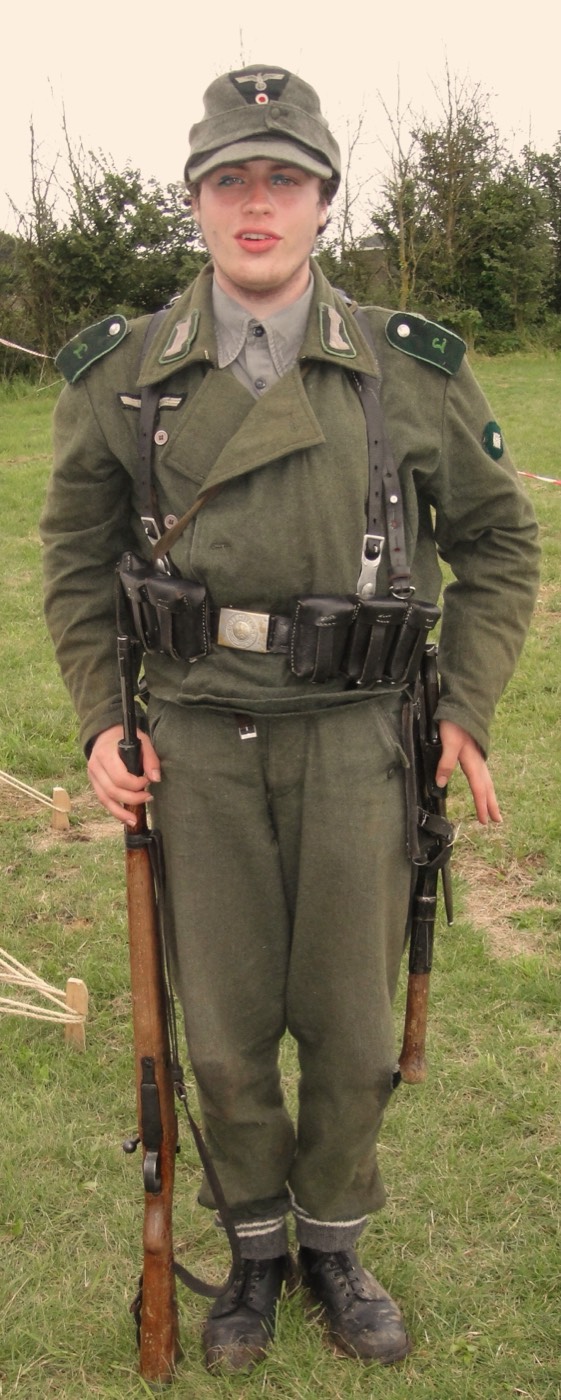
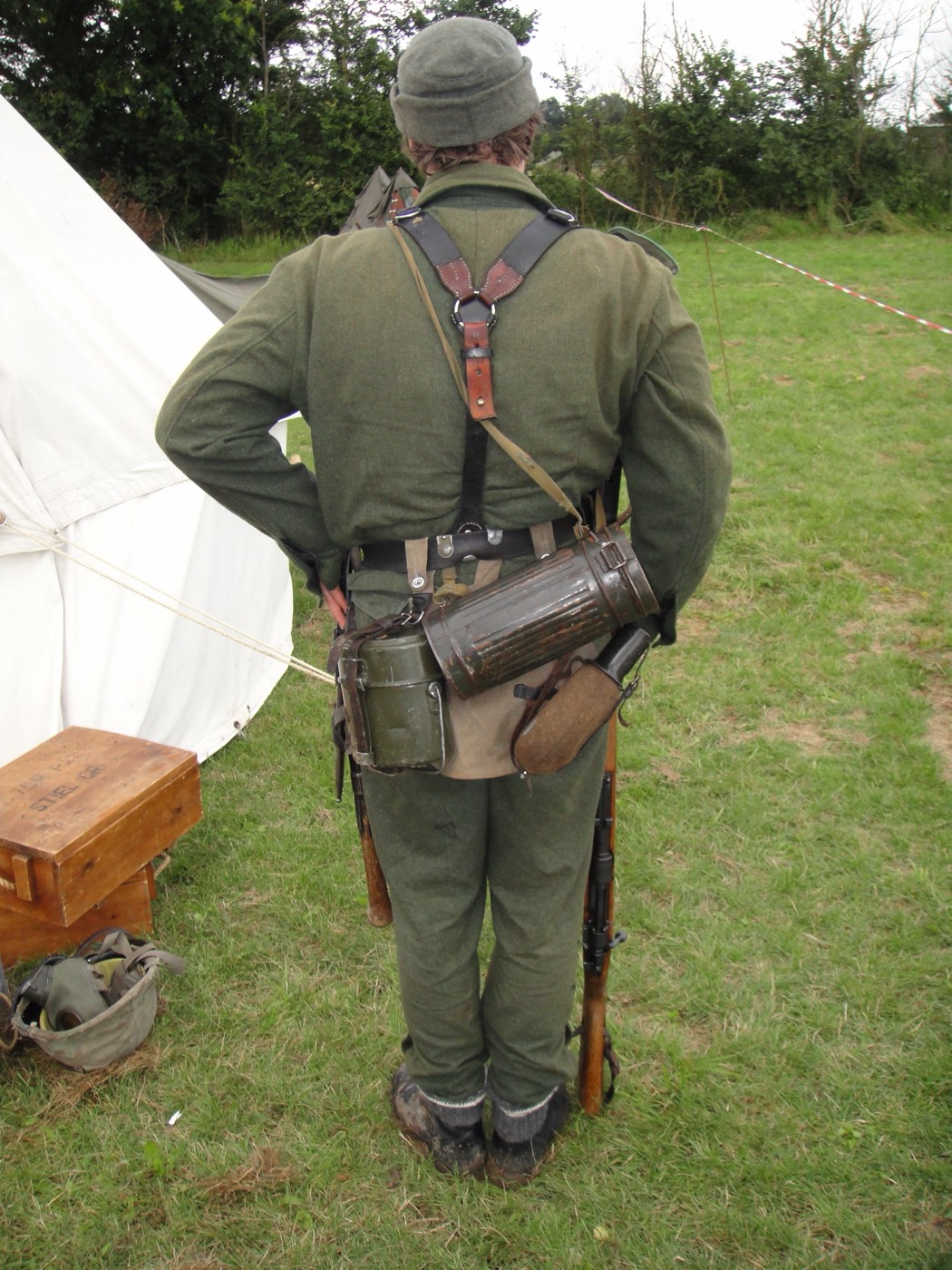
This is the basic loadout for a Grenadier. Every item shown here is Tier 1 in the uniform requirements, so it is what any new member should be getting first, before moving on to Tier 2. Select a marker on the photos, or an item in the list, to see what it is and what to look for.
Front
The Einheitsfeldmütze (standard field cap) came in from June 1943 and replaced the older side caps. It is field-grey wool with a long peak, and the side flaps fold down and button under the chin to keep the ears and neck warm. The eagle and cockade are worn on the front, either as a single T-shaped badge (as here) or as two separate pieces.
Look for: wool, not cotton, and a two-button front.
This is the Heer (army) version of the short, double-breasted field-grey wrap jacket, not the Waffen-SS pattern. It was made for assault-gun (Sturmgeschütz) crews. It was also issued to other units that fought from armoured vehicles. It is cut short at the waist so it doesn't catch inside a vehicle, and the buttons are hidden behind the wrap. Here it is worn with Heer collar tabs, the breast eagle, and shoulder straps piped in grass green, the arm colour (Waffenfarbe) of the Panzergrenadiers.
Look for: the Heer cut. The Waffen-SS version is not correct for Panzer Lehr.
The field-grey pullover shirt (Feldhemd) has a half-button front, a collar and two breast pockets. In summer the collar is often worn open over the tunic collar, as many Grenadiers did in Normandy in 1944.
The leather Y-straps (Koppeltraggestell) take the weight of the belt kit onto the shoulders. At the front, the two straps hook onto the back of the ammunition pouches. The infantry pattern has extra D-rings at the shoulders for clipping on the assault-pack frame or other gear.
The black leather belt (Koppel) carries all the field gear. The Heer buckle (Koppelschloss) is stamped steel or aluminium, painted or plain, with the eagle and the motto Gott mit uns. The belt is adjusted by the hooked tongue at the back, so the buckle sits in the centre.
The leather rifle ammunition pouches (Patronentaschen) each have three pockets. Every pocket holds two five-round clips for the K98k, so a pair carries 60 rounds. They are worn either side of the buckle, and the front hooks of the Y-straps clip onto the rings on their backs.
These are the Heer (army) field-grey wool trousers that go with the wrap jacket, not the Waffen-SS pattern. They are full in the leg and taper to the ankle, where they tie so they can be bloused over the socks and ankle boots.
Look for: the Heer cut. The Waffen-SS version is not correct for Panzer Lehr.
Short lace-up ankle boots (Schnürschuhe) replaced the tall jackboot from about 1940 to save leather. They have hobnailed leather soles and iron heel plates. The grey wool socks have white rings at the top that show the size, and these can be seen in the photo.
Look for: hobnailed soles. Rubber-soled boots are not correct.
The Mauser Karabiner 98 kurz was the standard German service rifle from 1935 to the end of the war. It is a bolt-action rifle in 7.92×57 mm, fed from a five-round internal magazine loaded with stripper clips. A leather sling is fitted.
Speak to the unit before buying one.
The standard bayonet (Seitengewehr 84/98) has a blade of about 25 cm, carried in a steel scabbard. The scabbard sits in a leather frog on the belt at the left hip, usually just in front of the entrenching tool.
Rear
The fluted steel canister (Tragbüchse) held the gas mask. It hangs from a shoulder strap and is hooked to the belt so it sits across the back of the hip, as in the photo. Troops in the field often used it for storing other things.
The M31 mess tin (Kochgeschirr) is a kidney-shaped aluminium or steel pot, painted green or field-grey. It has a deep lid with a folding handle that works as a frying pan or plate. It is strapped to the bread bag, as here, or to the back of the Y-straps.
The canvas bread bag (Brotbeutel) hangs from the belt on two leather tabs and holds rations, eating irons and personal kit. The rings along its bottom edge carry the canteen, and the mess tin can also be strapped to it.
The M31 canteen (Feldflasche) holds 0.8 litres. The aluminium or steel bottle is covered in brown felt and has a drinking cup held on by a leather strap. The strap's hook clips it to the bread bag.
The small entrenching tool (kleines Schanzzeug) is carried on the belt at the left hip in a leather or pressed-card carrier, with the bayonet frog in front of it. It is either the older fixed spade, as here, or the folding spade (Klappspaten) introduced from 1938.
From behind, the Y-straps meet at a ring between the shoulder blades, and a single strap runs down to the back of the belt. Adjust the straps so the belt sits level at the waist and the weight of the kit rests on your shoulders, not your hips.
The Stahlhelm has a steel shell with a leather liner and chinstrap. The M35 has a rolled edge and separate vent grommets. The M40 has the vents stamped into the shell, and the M42 drops the rolled edge for a plain, flared rim. By 1944 most helmets had a single eagle decal or none at all, and a rough field-grey finish. Wire, nets or foliage were often added for camouflage.